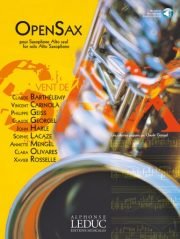
Pour / for: jeune saxophoniste conteur / young storytelling saxophonist
Durée / Duration: 1’30
Niveau / Level: fin de cycle I / 3-4 years of practice
Création / First performance: Juillet 2015 par Lucien Boucart, élève de la classe de Fabien Chouraki au CRR de Bordeaux, Congrès et Festival SaxOpen, Strasbourg. France / July 2015 by Lucien Boucart, student of JFabien Chouraki’s class at the CRR in Bordeaux, International Congress and Festival OpenSax, Strasbourg, France
« Fût-ce en mille éclats Elle est toujours là – La lune dans l’eau » Ueda Chôshû (1852 – 1932)
————
« Shattered in fragments, Yet always there— The moon in the water. » Ueda Chôshû (1852 – 1932)
Presse / Press
La lune dans l’eau (pour jeune saxophoniste conteur)
‘… Sophie Lacaze, compositrice pour qui les mots et les textes ont beaucoup d’importance, transforme le saxophoniste en conteur, ornementant le texte de douces textures et de gouttes d’eaux percussives des clefs de l’instrument, autant de perles venant colorer la musicalité des mots et le sens des notes.’
‘… Sophie Lacaze, a composer for whom words and texts hold great importance, she transforms the saxophonist into a storyteller, embellishing the text with soft textures and percussive water-like drops from the instrument’s keys—tiny pearls that enhance the musicality of the words and the meaning of the notes.’
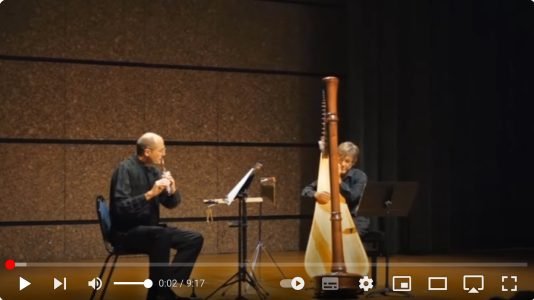
Création / First performance: Mai 2015 par Michel Raynié (flûte) et Fabrice Pierre (harpe), saison de l’Opéra Orchestre National de Montpellier, Montpellier, France / May 2015 by Michel Raynié (flute) and Fabrice Pierre (harp), Opéra Orchestre National de Montpellier season, Montpellier, France.
Commande / Commissioned by: Michel Raynié
Dédié à / Dedicated to: Michel Raynié et Fabrice Pierre
Les trois pièces d’Au milieu de la plaine s’inspirent de haïkus de Matsuo Bashô et de Kobayashi Issa, qui célèbrent la beauté et la simplicité de la nature.
1. « Au milieu de la plaine chante l’alouette libre de toute chose » (Matsuo Bashô)
2. « Ah, sérénité Et au fond des eaux du lac La cime des nuages » (Kobayashi Issa)
3. « Ondulante serpentante La brise fraiche Vient à moi » (Kobayashi Issa)
The three pieces of Au milieu de la plaine (In the Middle of the Plain) are inspired by haikus by Matsuo Bashō and Kobayashi Issa celebrating the beauty and simplicity of nature.
1. « In the middle of the plain sings the lark free from everything. » (Matsuo Bashô)
2. « Ah, serenity And at the bottom of the lake’s waters The summit of the clouds » (Kobayashi Issa)
3. « Winding and twisting, The fresh breeze Comes to me » (Kobayashi Issa)
Nomenclature : piano (pianiste professionnel) ou piano à 4 mains (pianistes amateurs)
Durée / Duration: 1’10
Création / First performance: Février 2015 par Mariano Ferrandez à Evere, Belgique / February 2015 by Mariano Ferrandez in Evere, Belgium.
Editeur / Publisher: Sophie Lacaze
« Un parapluie et un manteau de paille » est une miniature pour piano inspirée par un haiku du poète japonais Yosa Buson : « Pluie de printemps un parapluie et un manteau de paille vont ensemble devisant »
Cette courte pièce peut être jouée par un pianiste professionnel ou deux jeunes pianistes (un au clavier, l’autre dans les cordes) de fin de 1e cycle.
———————-
« Un parapluie et un manteau de paille » (An umbrella and a straw coat) is a piano miniature inspired by a haiku by the Japanese poet Yosa Buson:
« Spring rain an umbrella and a straw coat walk along, conversing »
This short piece can be performed by a professional pianist or by two young pianists (one at the keyboard, the other playing inside the strings) after 3 or 4 years of practice.
—————
La partition peut être téléchargée gratuitement à partir de cette page. The sheet music can be downloaded for free from this page.
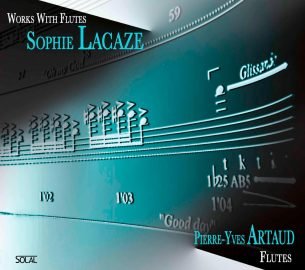
Premier enregistrement / First recording: 2007 par Pierre-Yves Artaud (flûte) et Fuminori Tanada (piano) pour le CD « Sophie Lacaze – Works with flutes » (SOLAL, Allemagne, 2008) / 2007 by Pierre-Yves Artaud (flute) and Fuminori Tanada (piano) for the CD « Sophie Lacaze – Works with flutes » (SOLAL, Germany, 2008)
Création en concert / First performance in concert: Juillet 2014 par Mathilde Caldérini (flûte) et Eloïse Bella-Kohn (piano), Festival de RadioFrance & Montpellier, Montpellier, France / July 2014 by Mathilde Caldérini (flute) and Eloïse Bella-Kohn (piano), Festival de RadioFrance & Montpellier, Montpellier, France
Dédié à / Dedicated to:Pierre-Yves Artaud
Editeur / Publisher: Sophie Lacaze
« Py pour flûte et piano, dédiée à Pierre-Yves Artaud, enchaîne deux parties : la première partie, lente, statique, s’inspire des grands espaces et déserts de l’Australie. On y trouve, dans le traitement de la flûte, quelques réminiscences de « and then there was the sun in sky ».
La seconde partie, danse de plus en plus sauvage et désarticulée, fait tout d’abord appel à des rythmes qui font penser à des danses ou cérémonies rituelles. Ces rythmes sont bientôt abandonnés au profit d’un déferlement de notes au piano, ensuite rejoint par la flûte, sorte de frénésie que seule une remontée du registre des deux instruments – regard vers le ciel, recherche des dieux ? – pourra apaiser. »
Geneviève Mathon.
———
“Py for flute and piano, dedicated to Pierre-Yves Artaud, is in two parts: the first, slow and static, is inspired by the wide open spaces and deserts of Australia. The treatment of the flute is reminiscent of “and then there was the sun in sky”.
The second part, an increasingly wild and disjointed dance, begins with rhythms reminiscent of ritual dances or ceremonies. These rhythms are soon abandoned in favor of a surge of notes on the piano, then joined by the flute, a kind of frenzy that is only calmed by a rise in the register of both instruments – a look to the sky, a search for the gods? – is the only way to calm things down. »
Pour / for: percussions (vibraphone, gong, crotale ou bol tibétain en la)/ percussions instruments (vibraphone, gong, antique cymbal or Tibetan bowl in A)
Durée / Duration: 9′
Création / First performance: Avril 2014 par Laurent Mariusse, Festival Turbulences Sonores, Montpellier, France / April 2014 by Laurent Mariusse, Festival Turbulences Sonores, Montpellier, France.
Commande / Commissioned by: Festival Turbulences Sonores
Dédié à / Dedicated to: Laurent Mariusse, Yu-Hsuan Pai et Thierry Miroglio
“Maye” a été composé 2014 et a été créé en avril de la même année par le percussionniste Laurent Mariusse à Montpellier, France, pour le festival Turbulences Sonores. Le concert été constitué de pieces pour percussions inspires par l’Asie du sud est ou ayant des liens avec cette region du monde.
“Maye” est une oeuvre en 3 parties pour vibraphone et gong. Chaque partie est basée sur un pelog, un des principaux modes de la musique pour gamelan originaire de Bali et Java, en Indonésie. En javanais, « Maye » se traduit par « imaginaire » ou « irréel ».
Dans cette pièce, Sophie Lacaze utilise les trois modes les plus courants à Bali : – Pelog Selisir pour la 1ère partie, – Pelog Sunaren pour la 2ème partie, – Pelog Tembung pour le dernier.
La 2e partie s’inspire librement du bubaran “Udan Mas”, une pièce de musique traditionnelle de Java.
Maye a été revue en 2022 par la compositrice.
—————-
« Maye » was composed in 2014 and premiered in April of the same year by percussionist Laurent Mariusse in Montpellier, France, for the Turbulences Sonores festival. The concert consisted of percussion pieces inspired by Southeast Asia or having connections with this region of the world.
« Maye » is a three-part work for vibraphone and gong. Each part is based on pelog, one of the main musical modes for gamelan, originating from Bali and Java in Indonesia. In Javanese, « Maye » translates to « imaginary » or « unreal. »
In this piece, Sophie Lacaze uses the three most common pelog modes in Bali: – Pelog Selisir for the first part, – Pelog Sunaren for the second part, – Pelog Tembung for the last part.
The second part is loosely inspired by bubaran « Udan Mas », a traditional piece of music from Java.
Pour / for: 4 ou 5 voix de femmes / 4 or 5 women’s voices
Durée / Duration: 12’30
Textes / Texts: Hildegard von Bingen
Création de la version pour 4 voix / First performance of the version for 4 voices: Février 2014 par Mora Vocis – voix solistes au féminin, Gosnay, France / February 2014 by Mora Vocis – voix solistes au féminin, Gosnay, France.
Création de la version pour 5 voix / First performance of the version for 5 voices: Juin 2016 par l’ensemble Egeria, Styriarte Lunchkonzerte à Graz, Autriche / June 2016 by the Egeria ensemble, Styriarte Lunchkonzerte, in Graz, Austria.
« O Sapientia » chanté par Mora Vocis, cathédrale Sainte Cécile d’Albi, Juillet 2016 ‘O Sapientia’ sung by Mora Vocis, Sainte Cécile cathedral, Albi, France, July 2016
« O Sapientia est composée sur le début de la Sixième Vision de Hildegard von Bingen, ainsi que sur ses textes O virtus Sapientiae et Caritas abundat in omnia.
La matière vocale intense (quatre voix en présence), fiévreuse, suppliante, parfois agitée, sur des voyelles en longues tenues vibrantes, l’alternance voix récitées-voix chantées et la mise en espace par le déplacement des chanteurs (apparition/disparition) donnent une force singulière à ces textes de Hildegard.
Les vibrations des voix et les textures vocales le plus souvent lisses et continues vont au cours de la pièce s’épaissir, se mettre en fibrillations par les vibratos, les trilles, l’intensité variable des dynamiques et par les voix qui peu à peu s’immiscent dans la texture initiale : un mi bémol fondamental, teneur, drone.
La pièce est découpée en 5 sections – chacune adoptant un régime vocal particulier : voix simple ; en polyphonie serrée et dense ; en liberté (éclats de voix) ; en itération (répétition obstinée) ; en incises du texte de Hildegard au sein de la texture vocale. Celle-ci peu à peu s’estompe sur la dernière incise en latin qui clôt la pièce. »
Geneviève Mathon
‘O Sapientia is based on the opening of Hildegard von Bingen’s Sixth Vision, as well as on her texts O virtus Sapientiae and Caritas abundat in omnia.
The intense vocal material (four voices present), feverish, suppliant, sometimes agitated, on long, vibrating vowels, the alternation of recited and sung voices, and the spatial setting through the displacement of the singers (appearance/disappearance) give a singular force to these texts by Hildegard.
In the course of the piece, vocal vibrations and textures, usually smooth and continuous, thicken and fibrillate with vibratos, trills, variable dynamic intensity and voices that gradually intrude on the initial texture: a fundamental E-flat, content, drone.
The piece is divided into 5 sections – each adopting a particular vocal regime: single voice; tight, dense polyphony; freedom (bursts of voices); iteration (obstinate repetition); and incisions of Hildegard’s text within the vocal texture. This gradually fades into the final incision in Latin that closes the piece.’
Pour / for: piano et orchestre à cordes / piano and string orchestra
Durée / Duration: 5’40
Création / First performance: Création de la 1e version en Décembre 2013 par Samuel Bismut (piano) et l’Orchestre à cordes du CRR et de l’Université Paul Valéry de Montpellier, direction Denis Comtet, à Montferrier, France / World premiere of the 1st version in December 2013 by Samuel Bismut (piano) and the Orchestre à cordes du CRR et de l’Université Paul Valéry de Montpellier, conductor Denis Comtet, Montferrier, France. Création de la version définitive en Mars 2015 par Alessandro Cesaro (piano) et I Solisti Veneti, direction Claudio Scimone, à Padova, Italie / First performance of the final version in March 2015 by Alessandro Cesaro (piano) and I Solisti Veneti, conductor Claudio Scimone, Padova, Italy.
Dédié à / Dedicated to: Claudio Scimone et I Solisti Veneti
« Immobilité sérieuse I », écrite en 2013, est la première d’une série de pièces pour instrument solo et orchestre à cordes de Sophie Lacaze. Hommage à Erik Satie, « Immobilité sérieuse I » est basée sur un motif tiré des « Vexations » que Satie avaient composées pour le piano, et qui avaient été créées à New York par John Cage et plusieurs de ses amis pianistes le jour de la naissance de la compositrice.
« Pour se jouer 840 fois de suite ce motif, il sera bon de se préparer au préalable, et dans le plus grand silence, par des immobilités sérieuses » Erik Satie.
—————
« Immobilité sérieuse I » (« Serious immobility 1 »), written in 2013, is the first piece of a series of works for solo instrument and string orchestra by Sophie Lacaze. Homage to Erik Satie, « Immobilité sérieuse I » is based on a pattern from Satie’s work « Vexations » that was composed for the piano. « Vexations » was premiered in New York by John Cage and several of his friends on Sophie Lacaze’s day of birth.
« In order to play this motif 840 times consecutively to oneself, it would be advisable to prepare oneself beforehand, in the deepest silence, by serious immobilities » Erik Satie.
Pour / for: quatuor de saxophones / saxophone quartet
Durée / Duration: 4′
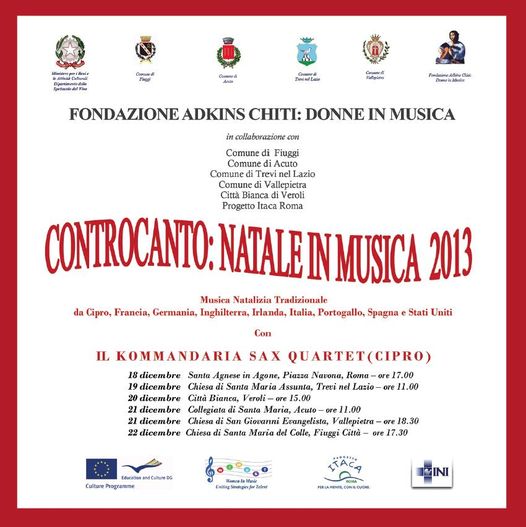
Création / First performance: Décembre 2013 par le Kommandaria Sax Quartet à Rome, Italie / December 2013 by the Kommandaria Sax Quartet in Roma, Italy.
Commande / Commissioned by: Fondazione Adkins Chiti: Donne in Musica
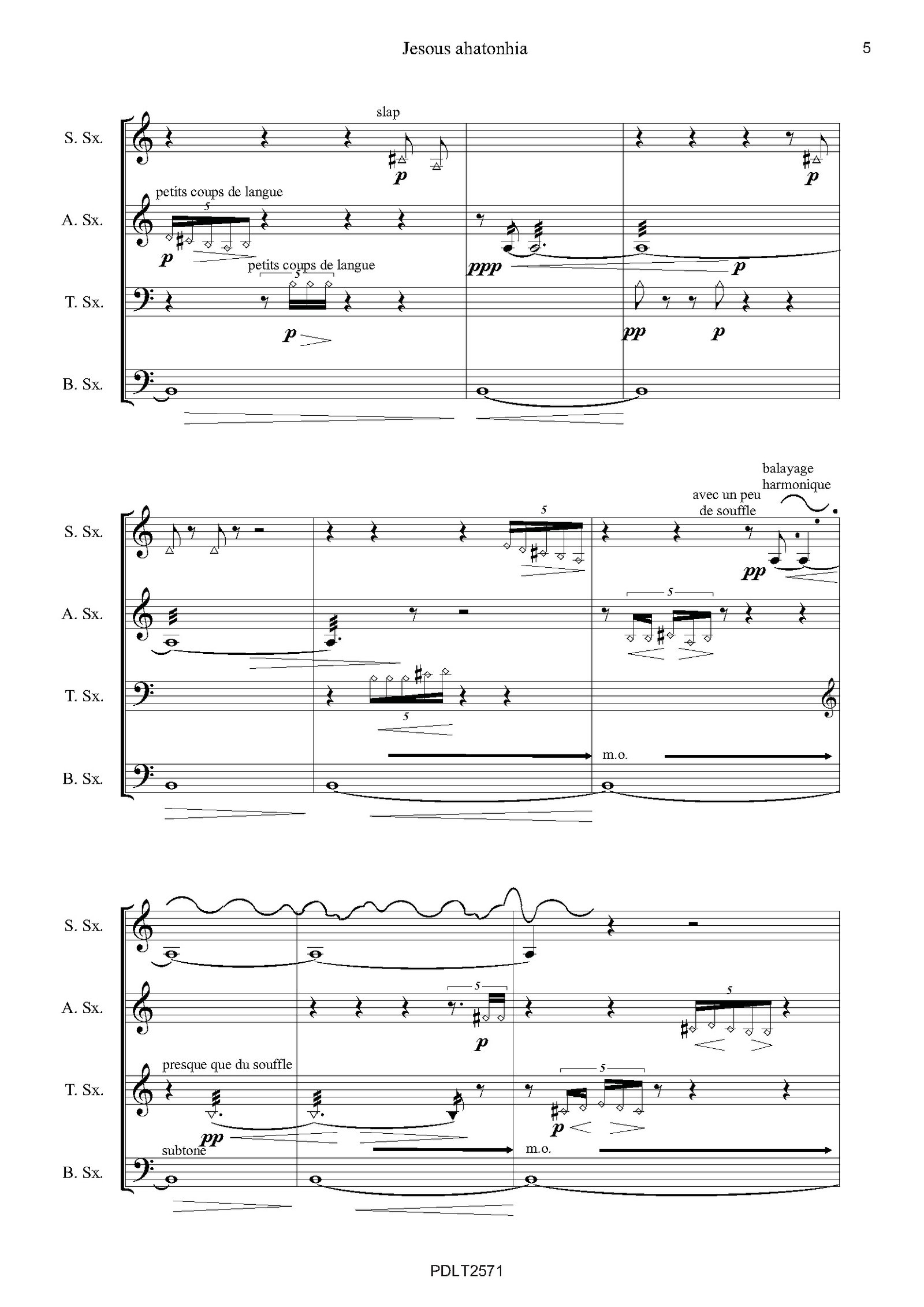
« Jesous ahatonhia », pour quatuor de saxophones, est une commande de la Fondazione Adkins Chiti: Donne in Musica pour sa saison de concerts ControCanto: Natale in Musica dans la région du Lazio (Italie) en 2013. La pièce a été créée par le Kommandaria Sax Quartet à Rome le 18 Décembre 2013.
« Jesous ahatonhia » (« Jésus est né ») est basé sur un chant de Noël écrit par le missionnaire Jean de Brébeuf en langue huronne au milieu du XVIIe siècle.
—————-
« Jesous ahatonhia », for saxophone quartet, was commissioned by the Fondazione Adkins Chiti: Donne in Musica for its concert series ControCanto: Natale in Musica in Italy in 2013. It was premiered in Roma on December 18, 2013, by Kommandaria Sax Quartet.
« Jesous ahatonhia » (« Jesus is born ») is based on a Christmas carol known as the « Huron carol », written by the missionary Jean de Brébeuf in the native language of Huron people, in the mid-seventeenth century.
Pour / for: Ondes Martenot et Orchestre de Flûtes / Ondes Martenot and Flute Orchestra
Durée / Duration: 10′
Création / First performance: Février 2013 par Nadia Ratsimandresy et l’Orchestre de Flûtes Français, direction Joël Soichez, à Paris, France / February 2013 by Nadia Ratsimandresy and the French Flute Orchestra, conductor Joël Soichez, Paris, France.
Commande / Commissioned by: l’Orchestre de Flûtes Français
Dédié à / Dedicated to: l’Orchestre de Flûtes Français et Nadia Ratsimandresy
Pour / for: récitant.e, mezzo-soprano, saxophone alto et piano / narrator, mezzo-soprano, alto saxophone and piano
Durée / Duration: 10’30
Textes / Texts: Jean-Pierre Rosnay
1e enregistrement / 1st recording: Mai 2012 par Alain Carré (récitant), Amaya Dominguez (mezzo-soprano), Jean-Yves Fourmeau (saxophone alto) et Martin Surot (piano), pour le CD « Souffles », Editions de l’Astronome, France. May 2012 by Alain Carré (narrator), Amaya Dominguez (mezzo-soprano), Jean-Yves Fourmeau (alto saxophone) and Martin Surot (piano), for the CD « Souffles », Editions de l’Astronome, France.
Création en concert / First performance in concert: Décembre 2022 par l’Odelya Trio (Manon Blanc-Delsalle, mezzo-soprano ; Mari Ángeles Del Valle, saxophone ; Vittoria Quartararo, piano) et Estelle Haussner (récitante), Kunstation Sankt-Peter, Cologne, Allemagne. December 2022 by Odelya Trio (Manon Blanc-Delsalle, mezzosoprano; Mari Ángeles Del Valle, saxophone; Vittoria Quartararo, piano) and Estelle Haussner (narrator), Kunstation Sankt-Peter, Cologne, Germany.
Dédié à / Dedicated to: Jean-Pierre et Marcelle Rosnay
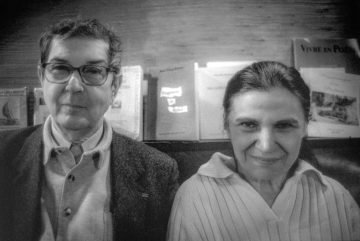
Jean-Pierre et Marcelle Rosnay au Club des Poètes, Paris, 2000 Jean-Pierre and Marcelle Rosnay at the Club des Poètes, Paris, 2000
« En Quête, pour voix de femme, récitant, saxophone alto et piano, a été composée pour une exposition de photographies de Guy Bompais mettant en scène un personnage solitaire, dont les pensées sont exprimées par des textes de Jean-Pierre Rosnay, tirés de son recueil Fragment et relief.
Le piano ouvre l’œuvre, il est le socle duquel peuvent émerger sons, phonèmes, mots. Le saxophone et la voix de mezzo-soprano s’unissent dans le souffle et adoptent en leur départ une écriture commune. Ce qui les différencie, c’est le mot, qui, à peine proféré, trouve une assise sémantique dans le texte du récitant. Les différents éléments sonores et textuels se lient dans une ascension inéluctable jusqu’à la rupture : « personne n’avait besoin de moi, même pas moi ».
Le deuxième moment est musique pure : il organise un contrepoint à trois voix autour de quelques notes polaires qui n’ont de cesse d’être brodées et soumises à un mouvement giratoire. Quand la parole du récitant revient, contrepoint absolu aux trois voix, celles-ci se délitent, perdent leur force articulatoire en glissandi informels. Le troisième et dernier moment redonne lien et cohérence entre voix et instruments et fournit la clé à cette énigme existentielle : « Qu’il me soit donné jusqu’au bout d’être digne et indifférent à moi-même », énoncé par la voix de mezzo-soprano, forte du verbe retrouvé dans son essence incantatoire.
L’énigme est musicale ; elle s’ordonne dans la confrontation (séculaire) entre musique et verbe, son et sens, pour laquelle la compositrice organise tout un parcours dont la solution se laisse entrevoir : il faut décliner le verbe, certes, mais sans céder à ce dernier et à son autorité naturelle, et lui redonner de la chair, de la présence, de la friabilité et de la magie.
Geneviève Mathon, pour le livret du CD « Il pleut des voix de femmes » (Paraty, 2023)
‘En Quête, for female voice, narrator, alto saxophone and piano, was composed for an exhibition of photographs by Guy Bompais featuring a solitary character, whose thoughts are expressed in texts by Jean-Pierre Rosnay, taken from his collection Fragment et relief.
The piano opens the piece, providing the foundation from which sounds, phonemes and words can arise. The saxophone and the mezzo-soprano voice unite in the breath and assume a common style as they start. What differentiates them is the word, which, as soon as it is uttered, finds a semantic basis in the text of the narrator. The different sound and textual elements are linked in an ineluctable ascent to the breaking point: « nobody needed me, not even me ».
The second moment is sheer music: it organises a three-voice counterpoint around a few key notes constantly woven together and subjected to a gyratory movement. When the narrator’s speech returns, an absolute counterpoint to the three voices, they disintegrate, losing their articulatory force through informal glissandi. The third and final moment reestablishes the link and consistency between voices and instruments and provides the key to this existential enigma: « May I be given to be dignified and indifferent to myself until the end », uttered by the mezzo-soprano voice, strengthened by the word retrieved in its incantatory virtue.
The enigma is a musical one; it is ordered in the (age-old) confrontation between music and lyrics, sound and meaning, for which the composer organises a whole trajectory, whose solution emerges: the word must indeed be used in different ways, but without surrendering to it and its natural authority, and it must be given flesh, presence, fragility and magic.’
Geneviève Mathon, for the booklet of the album « Il pleut des voix de femmes » (Paraty, 2023)
« … En Quête convoque une voix – celle de la mezzo Amaya Dominguez – un saxophone et un piano qui instillent par petites touches et alliages colorés le mystère et l’inquiétude au coeur du poème de Pierre Rosnay… »
Michèle Tosi, ResMusica, Jan. 2013, à propos du CD « Souffles » (les Editions de l’Astronome, 2012)
—————
« … Saxophone, piano, les voix, musique des mots, musiques des sons, Sophie Lacaze nous promène habilement dans son univers qu’elle maîtrise à merveille. … (elle) disperse habilement les notes, une à une qu’elle distille comme pour nous faire ressentir la quintessence des textes (crissements d’insectes, par exemple !) et de belles couleurs sonores. »
Stéphane Sordet, AsaxWeb, Oct. 2015, à propos de la partition de En Quête
—————
« … ‘En Quête’… The use of the narrator is well handled as the instrumental lines circle around each other. The “spoken canon” between singer and narrator is fascinating, flecked with instrumental pointillism, until they conjoin. »
Colin Clarke, Fanfare magazine, Mar. 2024, about the CD « Il pleut des voix de femmes » (Paraty, 2023)