
Quatre haikus
Pour / For: saxophone alto et piano / saxophone alto and piano
Durée / Duration: 10
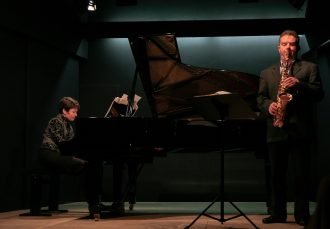
Création / Premiere: Décembre 2008 par Jean-Yves Fourmeau (saxophone alto) et Marylise Fourmeau (piano), Journées XX-XXI du CPMA, Annecy, France / December 2008 by Jean-Yves Fourmeau (saxophone) and Marylise Fourmeau (piano), Journées XX-XXI du CPMA, Annecy, France.
Commande / Commissioned by: CRR de Cergy-Pontoise
Dédié à / Dedicated to: Jean-Yves Fourmeau
Editeur / Publisher: Editions Billaudot
« Quatre haikus » ont été composés en 2008 à la demande du CRR de Cergy-Pontoise pour l’examen de la médaille de saxophone. Les 4 mouvements, très différents, s’articulent, autour de haikus de Yosa Buson (1716 – 1784), Yamaguchi Sodô (1642 – 1716), Kobayashi Issa (1763 – 1828) et Matsuo Bashô (1644 – 1694).
La création en concert a été donnée à Annecy en décembre 2008 par Jean-Yves Fourmeau, à l’époque professeur de saxophone au CRR de Cergy-Pontoise, et Marylise Fourmeau (piano).
————————–
« Quatre haikus » was composed in 2008 at the request of the CRR de Cergy-Pontoise for the saxophone medal examination. The 4 very different movements are based on haikus by Yosa Buson (1716 – 1784), Yamaguchi Sodô (1642 – 1716), Kobayashi Issa (1763 – 1828) and Matsuo Bashô (1644 – 1694).
The first performance in concert was given in Annecy in December 2008 by Jean-Yves Fourmeau, then saxophone teacher at the CRR in Cergy-Pontoise, and Marylise Fourmeau (piano).
Presse / Press
CD Souffles de Sophie Lacaze
« La rencontre du texte et de la musique qu’explorent toutes les pièces de cet album monographique de Sophie Lacaze n’est jamais aussi évidente et immédiate que dans Quatre Haïkus où le mot impulse le geste instrumental, l’évocation littéraire suggérant la texture sonore; une sensibilité très fine s’exerce dans ces quatre miniatures où la musique vient en réponse au verbe, dans un temps et un espace qui lui est propre. Sophie Lacaze y excelle, qui aime travailler dans la petite forme et l’économie du matériau… »
« The encounter between text and music explored throughout the works on this monographic album by Sophie Lacaze is nowhere more immediate and self-evident than in Quatre Haïkus, where the word sets the instrumental gesture in motion and literary evocation suggests the sonic texture. A remarkable sensitivity is at work in these four miniatures, in which music responds to the written word, unfolding in its own time and space. Sophie Lacaze excels in this form, with her particular fondness for working on a small scale and with a highly economical use of musical material… »
Michèle Tosi, ResMusica, 2 janvier 2013
Quatre haïkus
« Quand de prime abord, nous regardons la partition de Sophie Lacaze « 4 Haïkus », nous pensons que celle-ci n’est pas très difficile… C’est sans compter sur la subtilité et la précision de l’écriture de cette compositrice…
Comme le titre de la pièce l’indique, les quatre mouvements s’articulent autour de Haïkus (petit poème japonais extrêmement bref visant à dire l’évanescence des choses).
Le premier haïku est basé sur la pluie. Jeu d’imitation de la fine pluie de printemps qui tombe où entre le piano et le saxophone l’averse s’intensifie et se calme. Précision du détaché et des émissions, nuances équilibrées entre les deux instruments, slap et harmonique pour le saxophoniste, maintiens du tempo dans une partition où le silence a toute sa place…
…
… très belle pièce demandant une bonne maîtrise instrumentale. »
« When we first look at Sophie Lacaze’s score 4 Haïkus, we might think that it is not particularly difficult… But this is without taking into account the subtlety and precision of this composer’s writing.
As the title suggests, the four movements are built around haikus — extremely brief Japanese poems that seek to capture the transience of things.
The first haiku is inspired by rain: an evocation of the fine spring rain falling gently, with the downpour intensifying and then subsiding between the piano and saxophone interplay. Precision in articulation and attacks, carefully balanced dynamics between the two instruments, slap tongue and harmonics for the saxophonist, and a steady tempo in a score where silence plays an essential role…
…
… A beautiful piece requiring a high level of instrumental mastery. »
Stéphane Sordet, AsaxWeb, Décembre 2011